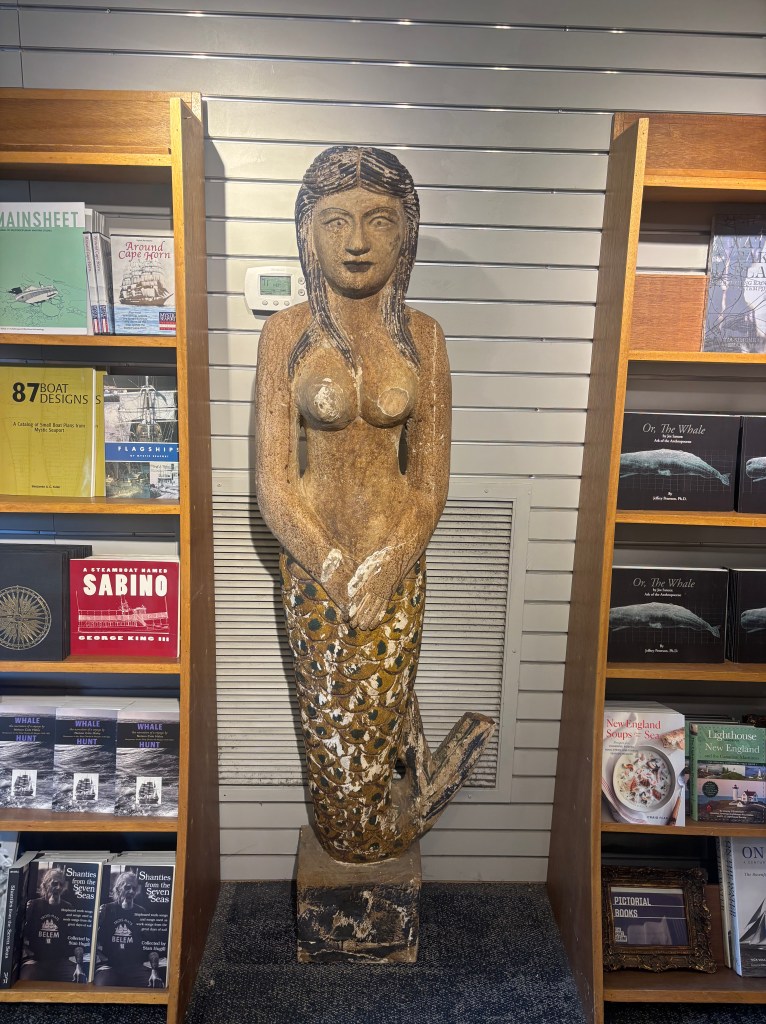
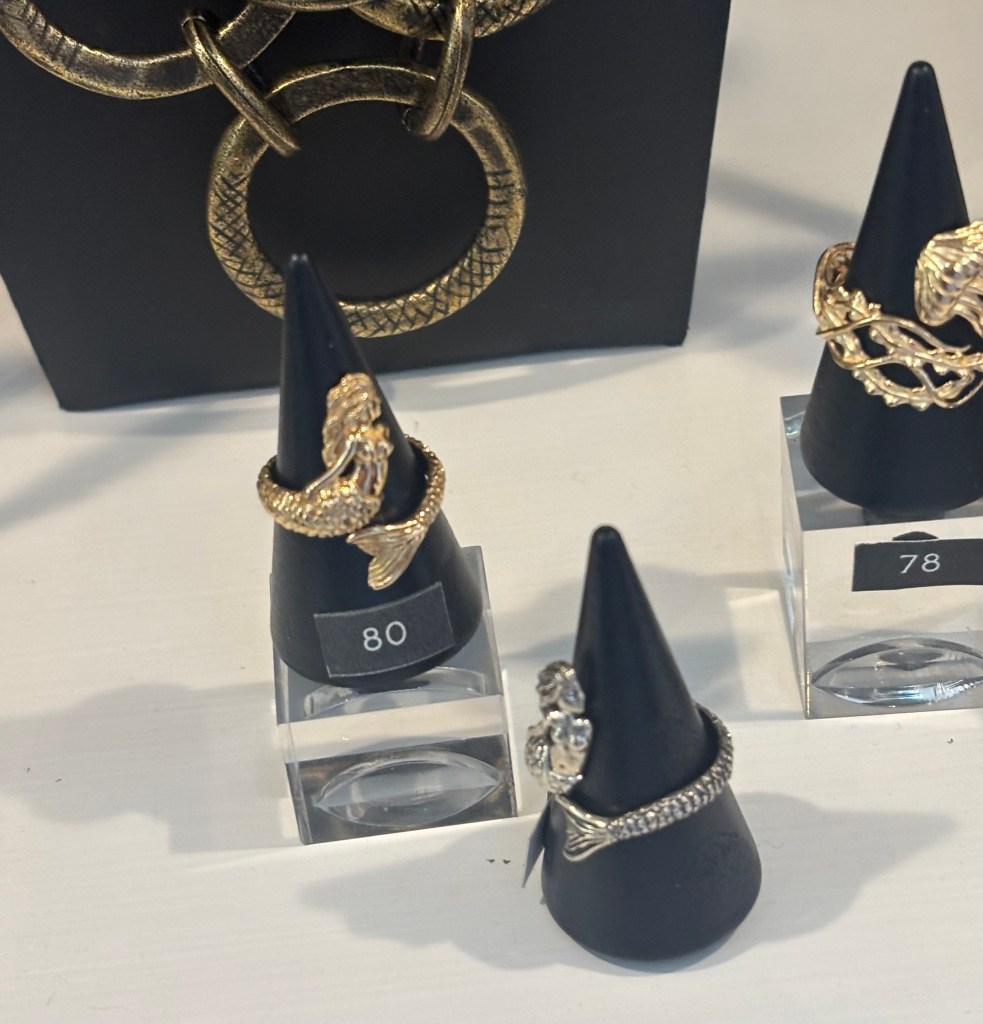
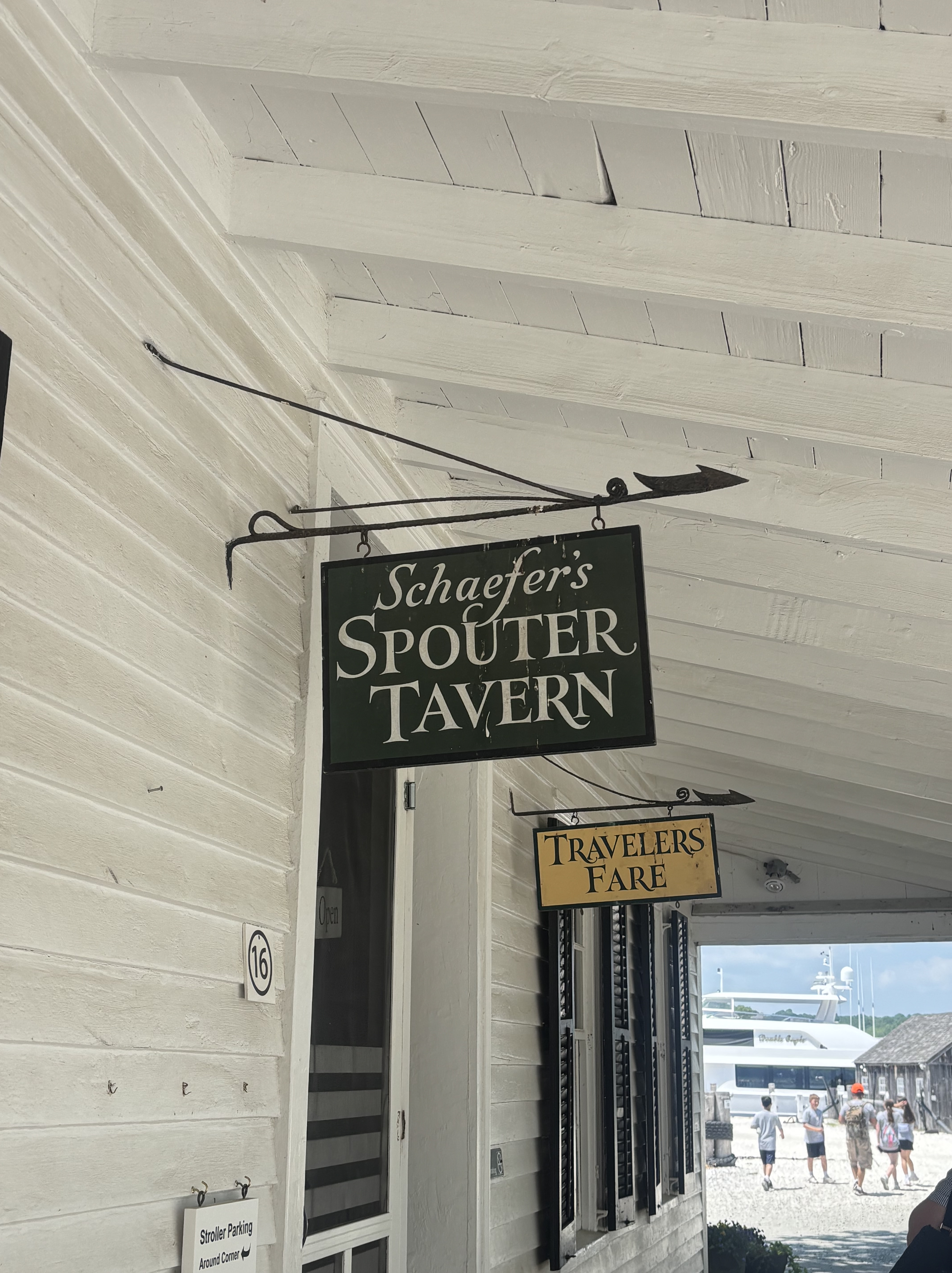
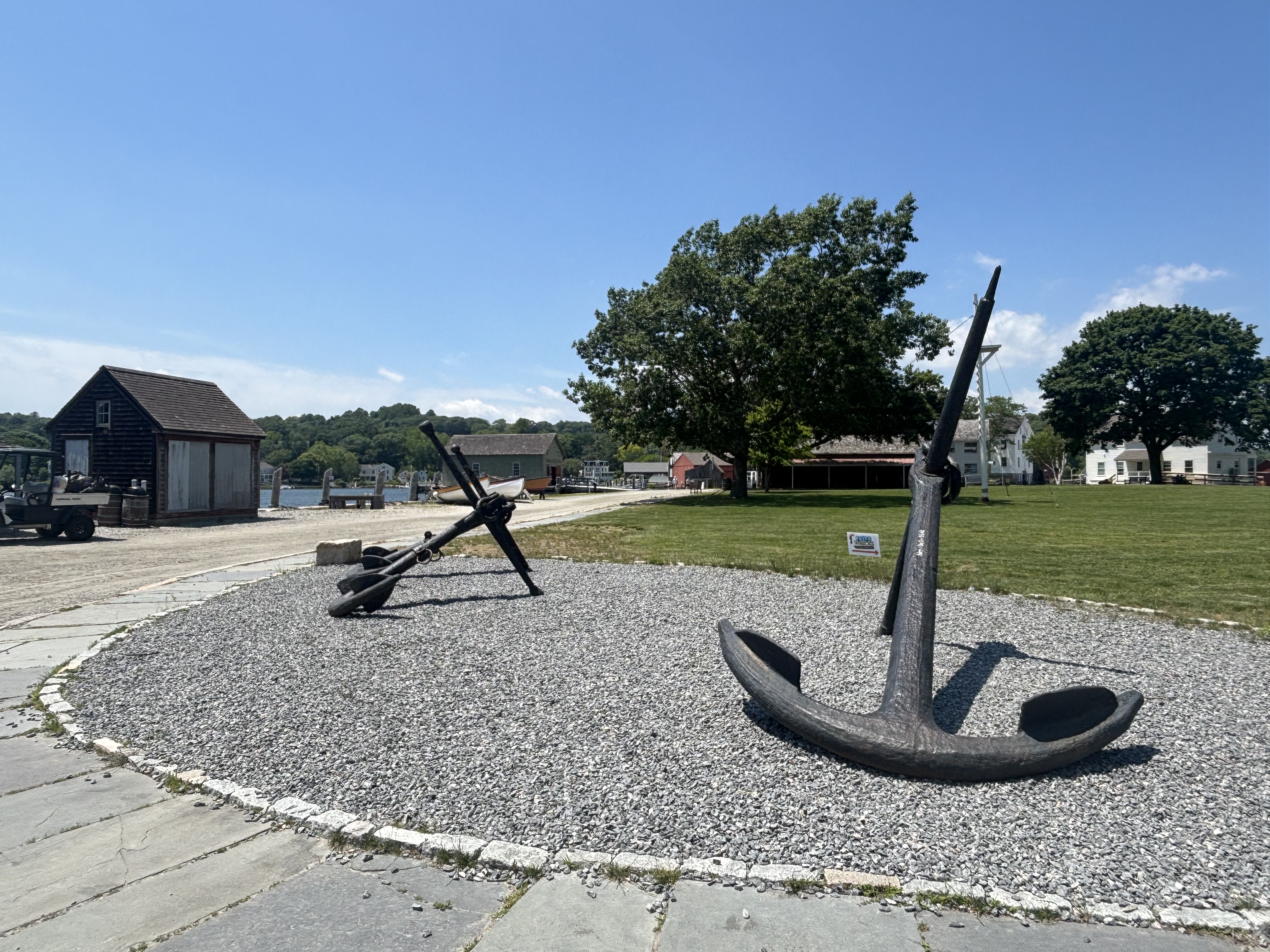
Despite my disillusionment with the celebratory depiction of commercial whaling among the tourist attractions of Mystic and Stonington, certain exhibits in the Mystic Seaport Museum offer a breath of fresh air. Sat on the bank of the Mystic River, about half a mile North of the Drawbridge, the museum is comprised of several buildings and exhibits all designed to replicate how the town would have looked in the nineteenth-century. Visitors can walk along the banks of the river, stepping in and out of medicinal shops, churches, and taverns adorned with Victorian-era furniture, lamps, and other props. One café alongside the gravel walkway circling the museum’s buildings is even named the “Spouter Tavern”, a minor nod to the inn that Ishmael visits in the opening chapters of Moby Dick.
‘Moving on, I at last came to a dim sort of out-hanging light not far from the docks, and heard a forlorn creaking in the air; and looking up, saw a swinging sign over the door with a white painting upon it, faintly representing a tall straight jet of misty spray, and these words underneath – “The Spouter Inn” – Peter Coffin’ – Melville, Moby Dick, 11.
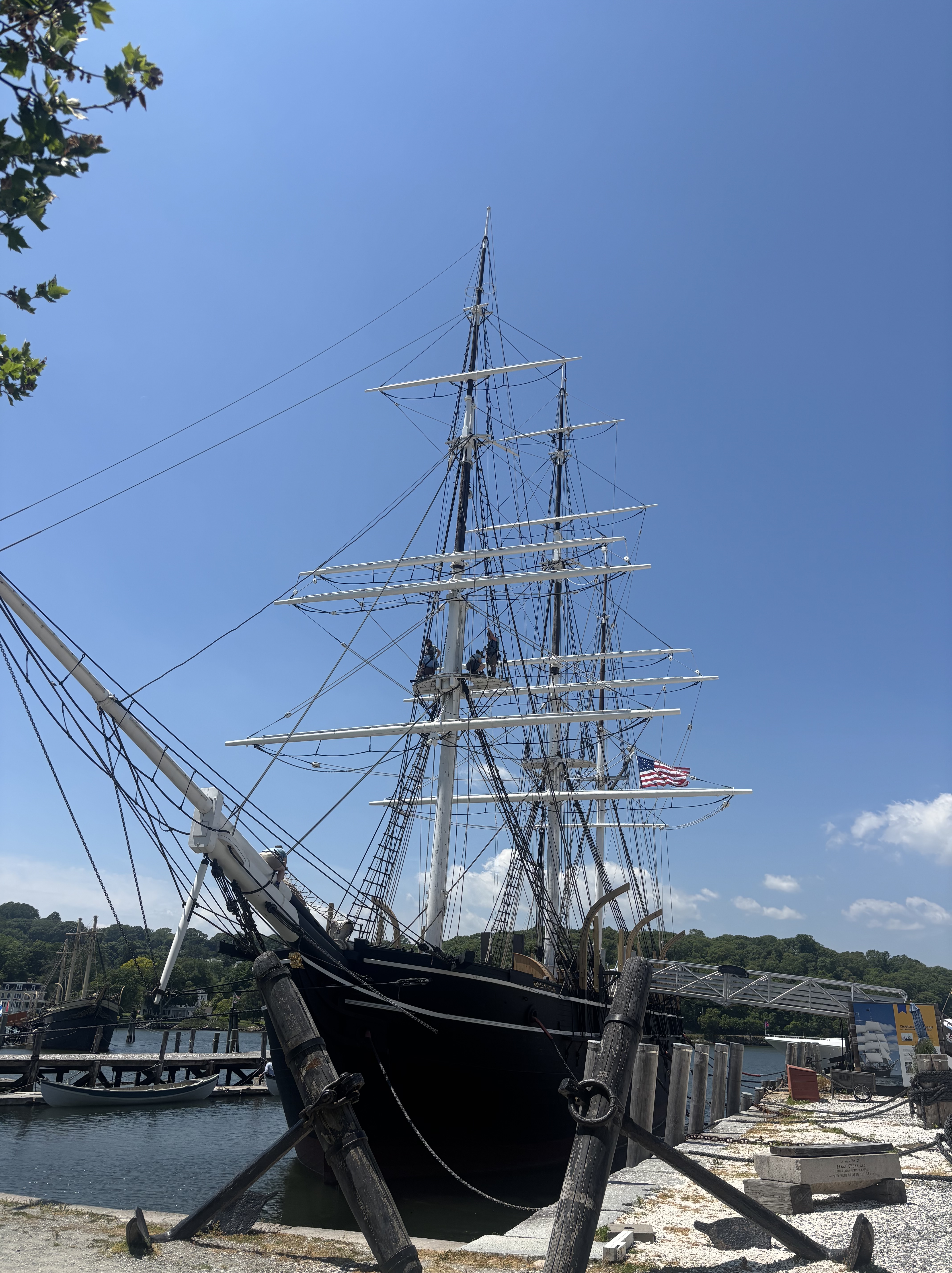
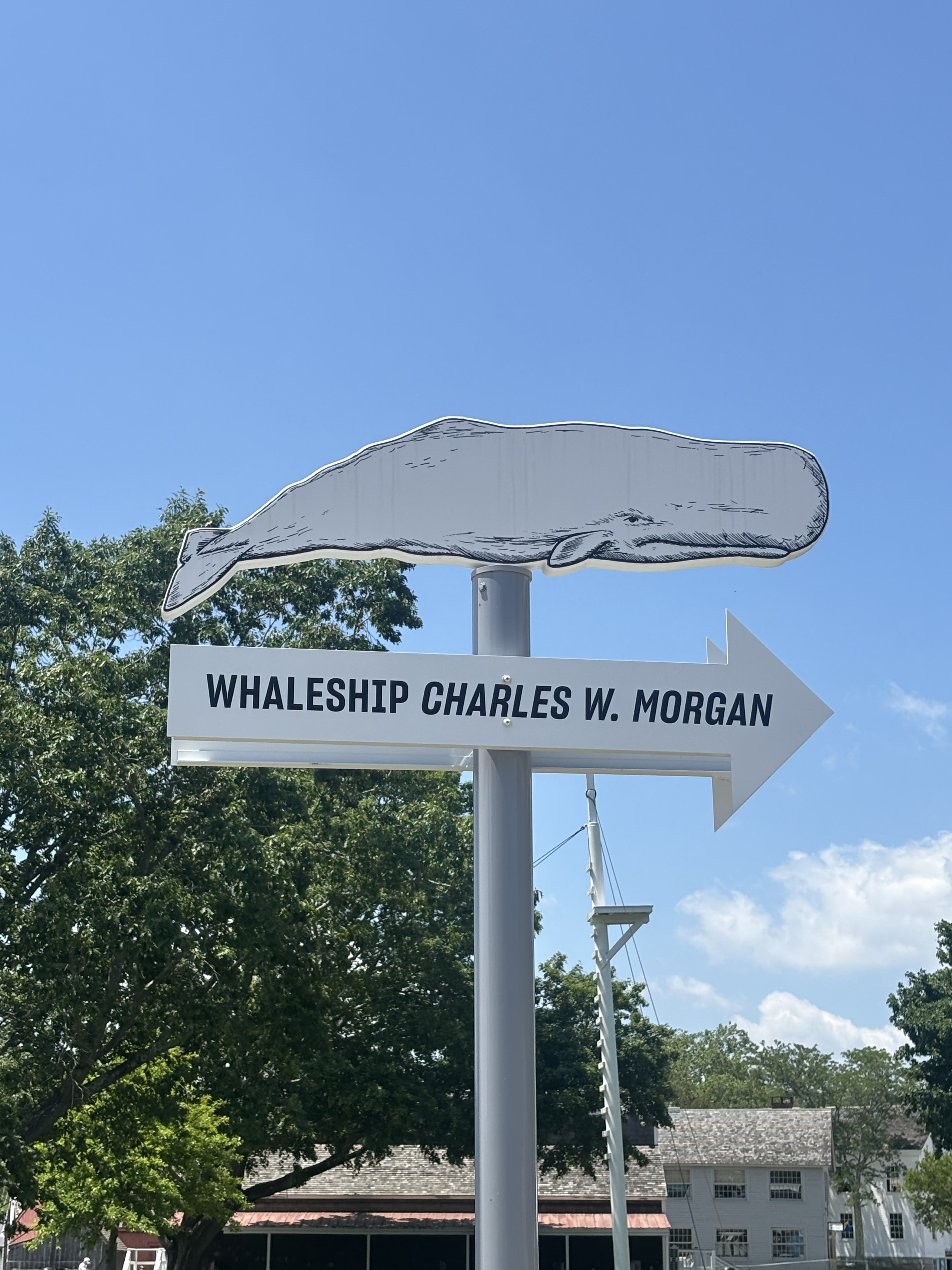
Signposts dispersed throughout the museum grounds also direct visitors to one of Mystic’s notable whaling relics – the Charles W. Morgan. Named after a notable whaling captain, the Morgan is the last surviving whaling vessel from the nineteenth-century. The ship was utilized for whaling voyages from 1841 to 1921, and has sat in the Mystic Seaport since the mid-20th century. In 2014, the Morgan sailed from Mystic to New Bedford, Massachusetts following years of restoration. Jamie Jones, one of the passengers aboard the Morgan’s recent voyage, describes the event as a reparative effort to dispel hetero-patriarchal and white supremacist narratives of Yankee whaling heritage in the early-twentieth century: “The 38th voyage reflected their efforts at telling a more accurate history of diversity among the whaling labor force; among the 38th voyagers were descendants of the Indigenous, Portuguese, Black, and white crew members who lived and labored on the ship” (Jones 185). Despite its transformation from whaling vessel to tourist attraction, the Morgan resists the romanticized narrative of New England whaling that other sites along the Mystic River continue to profit from.
The Charles W. Morgan is beautiful in person – but in a recent visit to the Seaport Museum, I was completely blown away by a different exhibit. Inside one of the more modern buildings of the museum lies the “Monstrous: Whaling and its Colossal Impact” exhibit. The exhibit hall is filled with dozens of harpoons, photographs, and other artifacts of nineteenth-century whaling, including a sperm whale jawbone resting at the center of the room. The crown jewel of this exhibit, however, is a 14- by 51- foot scratchboard mural in the shape of a sperm whale. The mural was created by artist Jos Sances in 2019, and is titled, Or, the Whale: Ark of the Anthropocene. Viewed at a distance, the artwork appears to be just a scratched-out drawing of a sperm whale. But as you get closer, it transforms to reveal “an intricate network of animate parts, immersing us in a pageant of hand-drawn figures and vignettes literally scratched into the whale’s illusionistic skin – fretwork reminiscent of the incisions of scrimshaw or tattooing, with larger gashes representing wounds from the barbed tentacles of giant squid – and inviting us to make meaning of the panoply of images and their provocative juxtapositions” (Peterson 10).
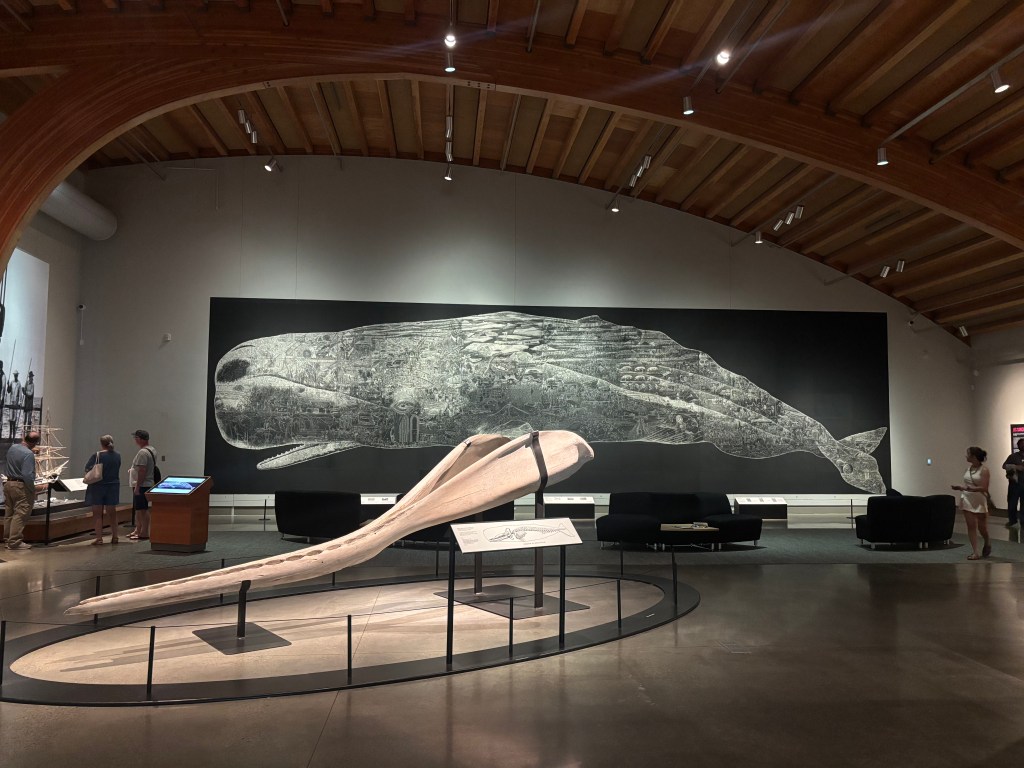
An information panel next to the mural explains that it is meant to be viewed, or read, from left to right – beginning at the sperm whale’s head and ending at its tail. Inside the whale’s outline, the figures and landscapes scratched into it depict Sances’ “history of America from 1851”, the year of Moby Dick’s publication, “to the present”. The interior drawings particularly shed light on the ravages of American capitalism, with graphic embodiments of enslaved Africans, child coal miners, and Native American residential schools. Landscapes of devastated oceans, forests, and tundras also accompany seas of plastic bottles, contaminated waters, and forest fires in a simultaneous overlay of climate disaster. It would be easy to spend all day staring up at the intricate details of this mural, and would most certainly take several hours to dissect every figure or social, political, and ecological reference included in Sances’ design. It is even difficult to limit which pieces of the whale stand out the most to me, but I’ve included a few of them below.
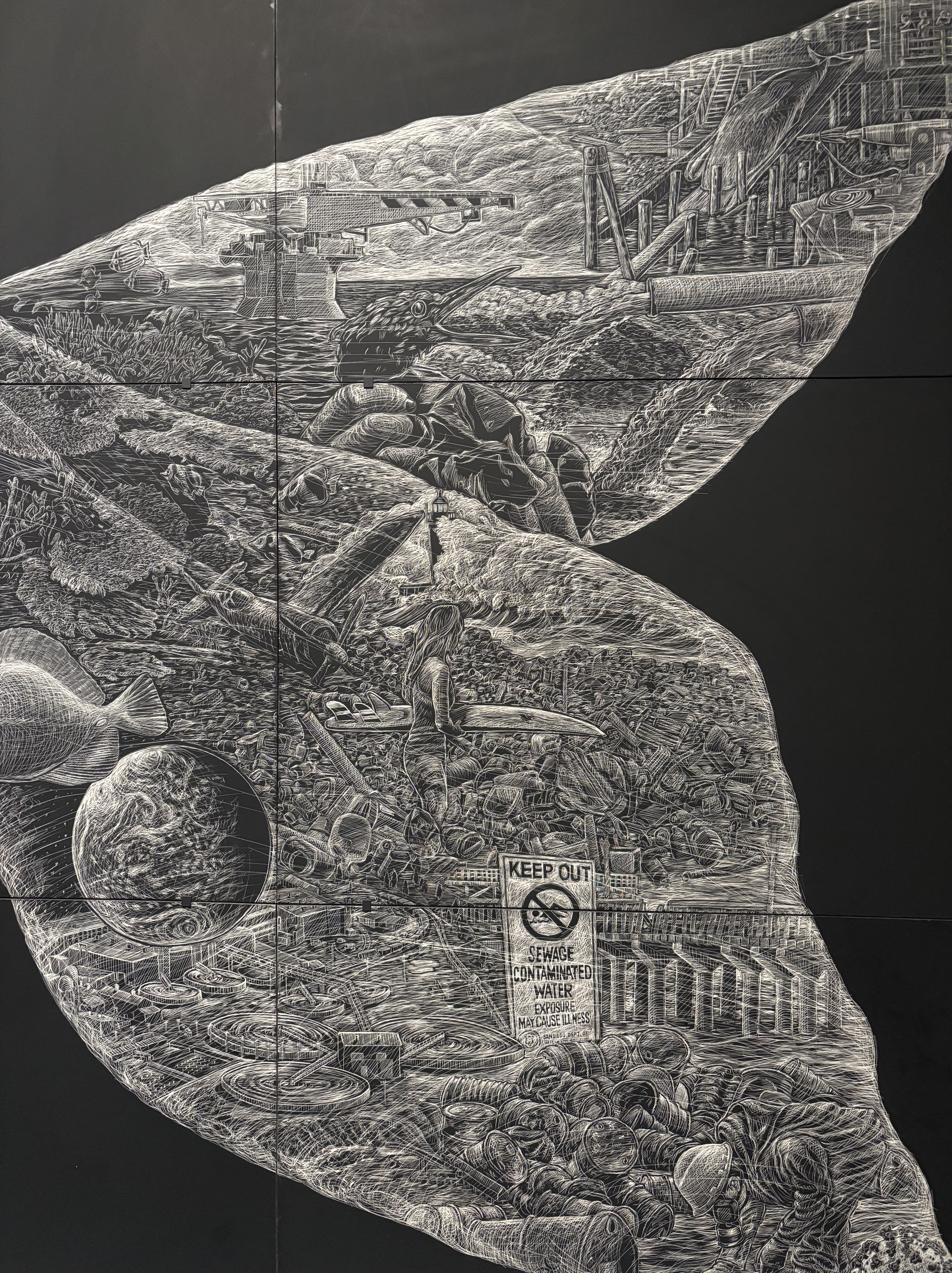
This section of the whale’s tail depicts an ocean experiencing a multitude of ecological disasters — in the bottom half a female surfer wades through a beach covered in trash, while below, a man appears to be picking up cartons of oil or waste in front of a sign reading “Sewage Contaminated Water”. The physical act of carving depictions of oceanic disaster onto the body of a whale reminded me of several remarks made in Rebecca Giggs’ Fathoms — primarily, her assertion that “no whale species was ever driven to extinction by whaling, for all its sweeping violence – but cetaceans have disappeared from the planet, already, as a result of pollution’ (Giggs 220). It is deeply troubling to imagine whaling as only the tip of the iceberg when it comes to anthropic threats to whale populations.
In this section, located near the whale’s head, I was instantly reminded of a segment in Moby Dick, in which Ishmael reflects on the potential extinction of the whale as a result of commercial whaling. Ishmael claims that, despite knowledge of other species driven extinct by capitalist hunting practices, like American bison, the singularity of whaling prevents the whale from suffering a similar fate: “Though so short a period ago — not a good life-time — the census of buffalo in Illinois extended the census of men in London, and though at the present day not one horn or hoof of them remains in all that region…” (Melville 502). Sances draws an American bison in this section, the gaze of which is directed outwards at the viewer. The bison stands in company with other well-documented injustices enforced upon Native American populations.
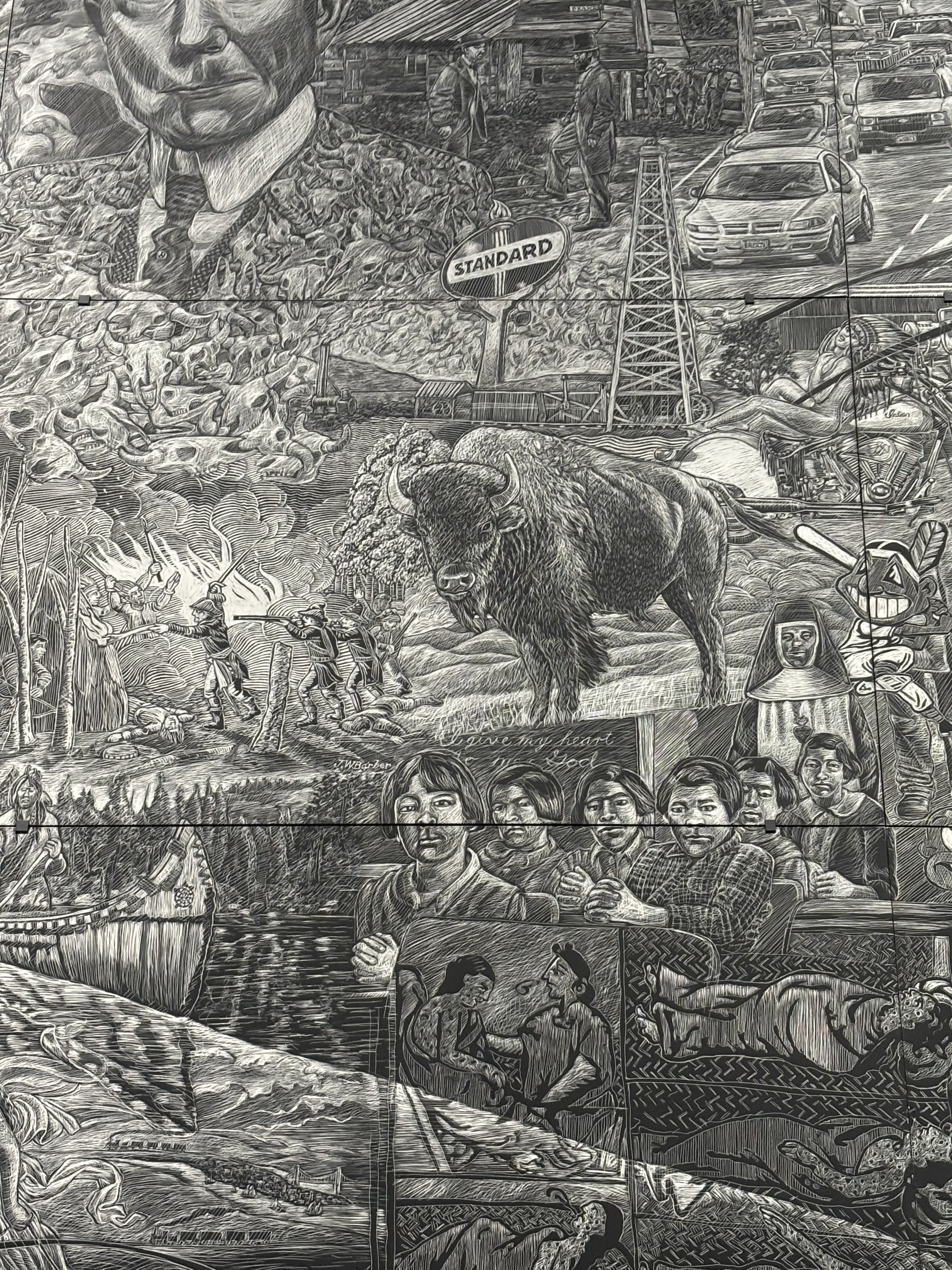
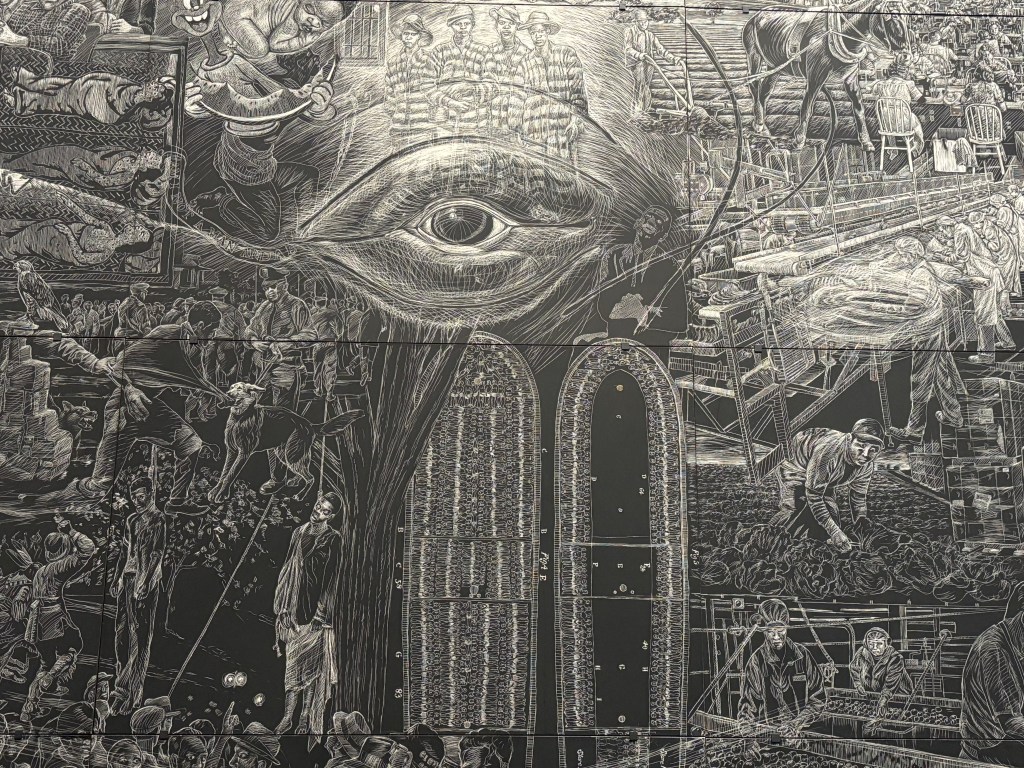
As difficult as it is to single out one portion of this mural as more affective than the rest, I was deeply moved by Sances’ rendering of the whale’s eye. Both Melville and Giggs contemplate the whale’s gaze as a unique point of encounter and confrontation between land and sea mammal. Pointing out the dispersion of the whale’s eyes on either side of its head, Melville writes that “the whale, therefore, must see one distinct picture on this side, and another distinct picture on that side, while all between must be profound darkness and nothingness to him…the peculiarity of the whale’s eyes is a thing always to be borne to mind in the fishery” (Melville 360). With this in mind, to make contact with a singular eye on one side of the whale, as opposed to two, almost makes the gaze of the whale seem more targeted. During a whale-watching trip in Australia, Giggs recalls a moment when a passing whale seemed to stare directly at her – in a surreal moment of role-reversal, she experiences “the time-freezing power of the whale, watching” (Giggs 92).
‘I am saying that those who survived in the underbellies of boats, under each other under unbreathable circumstances are the undrowned, and their breathing is not separate from the drowning of their kin and fellow captives, their breathing is not separate from the breathing of the ocean, their breathing is not separate from the sharp exhale of hunted whales, their kindred also.”
Alexis Pauline Gumbs, Undrowned: Black Feminist Lessons from Marine Mammals, 5.
To lock eyes with the whale is to no longer have the privilege to view it on one’s own perceptive terms, or to project a desired image of monstrosity, cuteness, or even wonder onto it. Instead, the human viewer is forced to reckon with the question of how the whale perceives them. Viewing this section of the mural, I feel that Jos Sances is acutely aware of the reckoning that comes with this gaze. Surrounding the whale’s eye are scratchboard illustrations depicting the horrors of American chattel slavery and the Jim Crow Era. Directly below the whale’s eye is a replica of the infamous slave ship diagrams from the Transatlantic Slave Trade. Joseph Peterson imagines the ship diagrams to resemble “an enormous double headstone (or teardrop)” hanging below the whale’s eye: “the eye of Sances’s Whale is…an organ of moral-political indictment: an obligatory space of reflection in which the plunder of Black bodies is made inescapably visible” (Peterson 40). Viewers do not meet the whale’s gaze to find humility in one’s humanity, or to experience a moment of multispecies connection. The whale stares back at the human viewer, and forces them to contend with the knowledge of one’s intrinsic personhood and human rights against the irrepressible history of genocide and dehumanization from which this country was founded.
As uncomfortable as this confrontation with history may feel, I think Sances’s mural exemplifies the kind of engagement with history that is essential to the project of combatting ongoing regimes of harm and destruction targeted against marginalized human and non-human communities across the globe. The value of this kind of engagement is amplified even more by the location of this mural among the tourist destinations of Mystic and Stonington. My hope is that other people – especially those just passing through town, eager to take advantage of the pleasant maritime aesthetics of the area and the accessible whales (symbolic and real) for public viewing – will see this mural and approach their engagement within these communities and beyond, with more awareness and compassion.